

Nicholas DiPatrizio, Ph.D.
Professor, Biomedical Sciences
Director, UCR Center for Cannabinoid Research
University of California Riverside
Title of Presentation:
To eat or not to eat? Cannabinoid control of food intake and energy metabolism
Dr. Nicholas DiPatrizio is a Professor of Biomedical Sciences in the School of Medicine at UCR, and Founding Director of the UCR Center for Cannabinoid Research. The DiPatrizio laboratory investigates roles for the endocannabinoid system in the integrative neurobiology and physiology that controls food intake, energy homeostasis, and reward, and dysregulation of these pathways in metabolic disorders.
Moreover, the DiPatrizio laboratory studies the impact of cannabis exposure on endocannabinoid system function in metabolic health and disease. This work will support the discovery and development of novel therapeutic strategies to safely treat obesity, type-2 diabetes, and related disorders.

Stephen Lankenau, Ph.D.
Professor, Community Health and Prevention
Director, Medical Cannabis Research Center
Drexel University
Title of Presentation:
Tolerance breaks and other forms of controlled cannabis use: Implications for clinical research and practice
Dr. Stephen Lankenau is a Professor in the School of Public Health and Director of the Medical Cannabis Research Center at Drexel University. Dr. Lankenau has published over a 100 peer-reviewed and other scholarly monographs focused on substance use and misuse, particularly in the areas of young adults, ketamine, prescription drugs, cannabis, and opioid overdose prevention.
Currently, he is leading a 5-year registry study of medical cannabis patients in Pennsylvania, co-leading a 15-year NIH-funded longitudinal study of young adults in California and Pennsylvania focused on controlled use of cannabis, and co-leading a 5-year NIH-funded study on opioid overdose prevention in Philadelphia using mobile phone technologies.

James MacKillop, Ph.D.
Professor, Psychiatry & Behavioral Neurosciences
Director, Center for Medicinal Cannabis Research
McMaster University
Title of Presentation:
Using behavioral economics to understand cannabis use and misuse
Dr. James MacKillop holds the Peter Boris Chair in Addictions Research and a Canada Research Chair in Translational Addiction Research at McMaster University and St. Joseph’s Healthcare Hamilton. There, Dr. MacKillop directs both the Peter Boris Centre for Addictions Research and the DeGroote Centre for Medicinal Cannabis Research.
His research uses a multidisciplinary approach that integrates psychology, economics, neuroscience, and genetics to gain unique insights into addiction and medical cannabis. Using the hybrid disciplines of behavioral economics, neuroeconomics, and genoeconomics, maladaptive decision making in health behavior is a core focus of his research program. Over the past two decades, Dr. MacKillop’s lab has generated 500 peer-reviewed publications and other works.
The Consortium for Medical Marijuana Clinical Outcomes Research is hosting its sixth annual conference, the Cannabis Clinical Outcomes Research Conference (CCORC), on November 5 & 6, 2026 at the UF Academic and Research Center at Lake Nona.
Take advantage of Early Bird Pricing for a limited time.

The Consortium for Medical Marijuana Clinical Outcomes Research (Consortium) received 28 proposals in response to its 2026 Request for Proposals (RFP), submitted by investigators from different consortium member institutions. These proposals were reviewed by ad-hoc out-of-state faculty reviewers with demonstrated expertise in the respective research area using NIH criteria for scientific review of research proposals. Funding recommendations were made after careful consideration of the merit of each proposal and its contribution to the consortium research mission by the consortium board. The consortium research mission per statute is to contribute to understanding the effects of medical marijuana use and to promote informed decisions regarding policy and clinical practice related to the treatment of debilitating medical conditions with marijuana.
Seven new awards along with one level 2 renewal will be made in the 2026 cycle of the Medical Marijuana Clinical Outcomes Research consortium grants program.

Examining the interplay between high genetic risk for psychosis and cannabis exposure
PI: Paola Giusti-Rodriguez, PhD

Mechanistic Mapping of the Neuro-Inflammatory Impact of Medical Marijuana on Older Adults with Chronic Pain in a Prospective Cohort
PI: Jennifer Hu, PhD
Role of cannabinoid-based therapeutics in the prophylaxis and treatment of Alzheimer's dementia
PI: Catherine Marcinkiewcz, PhD
Assessing Risks and Benefits of Medical Marijuana Formulations in a Rodent Model of PTSD
PI: Marek Schwendt, PhD
Advancing Nurse-led Cannabis Harm Reduction (ANCHOR)
PI: Renessa Williams, PhD
Impact of Medical Marijuana Use on IL-22–Mediated Mucosal Immunity and Microbiome Composition in Inflammatory Bowel Disease
PI: Mariola Ferraro, PhD
AI-Powered Analysis of Cannabis Use and Mental Health Outcomes: Age-Stratified Evidence from EHR Data
PI: Masoud Rouhizadeh, PhD
Evaluation of the Effects of Cannabis on the Glymphatic System and Sleep Quality in People with Multiple Sclerosis
PI: Teddy Salan, PhD
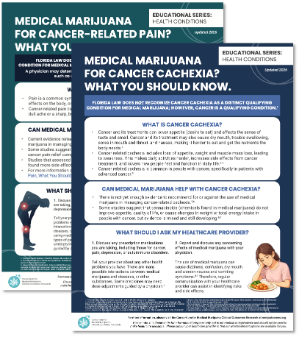
New info sheets have been created summarizing the evidence on effectiveness and safety of medical marijuana for the conditions of cancer, cancer-related pain, chemotherapy-induced nausea and vomiting, and cancer cachexia.
Other previously developed info sheets are focused on anxiety, Crohn’s disease, pain, epilepsy, and more.
We invite you to be part of advancing the science of medical cannabis.
Our Medical Marijuana Contact Registry connects patients and providers with ongoing and future research opportunities aimed at better understanding the health effects of cannabis.
Individuals who enroll will be asked to provide their name and complete a brief set of questions. This information helps our research team determine eligibility for current studies and, when appropriate, reach out about new opportunities. Participation is always voluntary and begins with an informed consent process that clearly explains the purpose of the registry, what information is collected, and how confidentiality is protected.
You can join the registry—or help others get involved—by visiting: mmjoutcomes.org/registry
If you are a provider, consider sharing this opportunity with your patients or within your clinic.
Thank you for supporting research that aims to improve patient care and inform evidence-based use of medical cannabis. For additional materials or questions, please feel free to reach out to mmj.outcomes@cop.ufl.edu.
MEMORY (MEdical Marijuana clinical Outcomes RepositorY) is a unique interlinked database which includes all registered medical marijuana users from the Florida the Medical Marijuana Use Registry (MMUR). To ensure comprehensive longitudinal follow-up and capture of relevant health outcomes, the Consortium has linked MMUR to administrative billing records of FL Medicaid and Center for Medicare and Medicaid (CMS) Medicare beneficiaries, as well as FL vitals database, allowing the investigation of medical marijuana related clinical outcomes and policy research.
The following figure shows the total number of unique individuals in different databases used in MEMORY, and also the number of unique individuals linked with MMUR data.
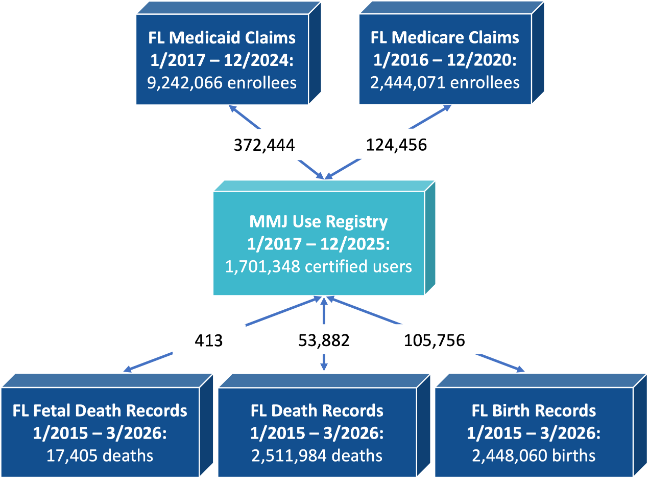
Total numbers by data source and the total number of linked individuals.
From May 29-31, 2026, the Consortium hosted a booth as part of its outreach efforts at the annual Florida Medical Cannabis Conference and Exhibition (FMCCE). The conference allowed the Consortium to connect with other researchers, clinicians, and industry professionals across the state.
Additionally, Assistant Professor Dr. Catalina Lopez-Quintero lead a session at FMCCE titled “Advancing the Science of Medical Cannabis: Research from Real-World Data to Clinical Trials.” This was a multidisciplinary panel featuring Dr. Juan Pérez, Dr. Md Mahmudul Hasan, and Dr. Karina Villalba. The session showcased real-world evidence from the Medical Marijuana and Me (M3) study, analyses of THC exposure and patient outcomes across conditions such as pain, anxiety, and sleep, and advances in data infrastructure through the MEMORY database. 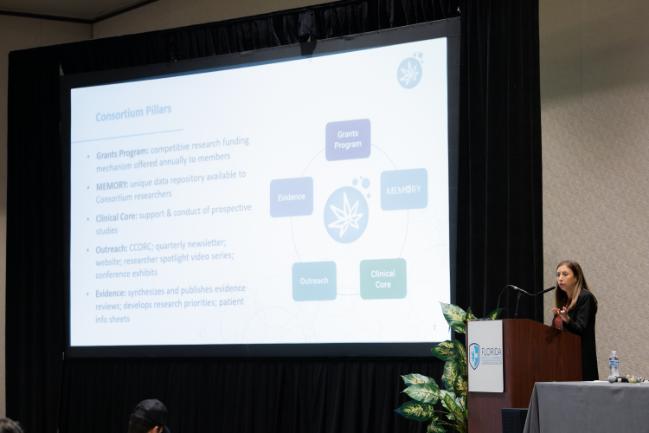
Dr. Catalina Lopez-Quintero leads a session at FMCCE 2026. 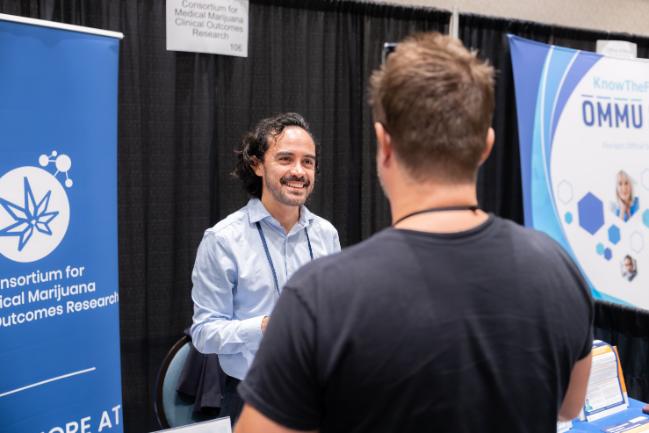 Juan Lopez speaks to attendees at the Consortium's booth at FMCCE 2026.

As cannabis use among patients with inflammatory bowel disease (IBD) continues to increase, questions remain about its effectiveness as a treatment option. In a new systematic review, researchers evaluated evidence from randomized clinical trials and controlled observational studies examining tetrahydrocannabinol (THC) containing cannabis products for IBD. The review followed rigorous Cochrane and PRISMA guidelines and assessed the quality of evidence using the GRADE framework.
Eight studies met the inclusion criteria, but the overall evidence was limited by high risk of bias and inconsistent findings. While some studies reported improvements in symptoms such as bloating and appetite, most outcomes, including disease activity, remission, pain, quality of life, and endoscopic findings, showed little or no meaningful benefit compared with control groups. The authors conclude that current evidence remains inconclusive and emphasize the need for larger, higher-quality studies to better understand the potential role of THC-containing cannabis products in IBD treatment.
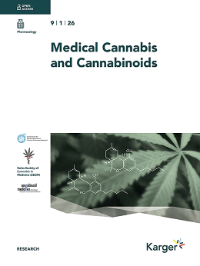
Medical Cannabis and Cannabinoids is the official journal of the Consortium, offering an international forum to investigate cannabis safety and effectiveness when used for medical purposes. This series in the newsletter, Journal Corner, provides updates, information and resources from the journal publisher, Karger.
New from Consortium Members
Medical Cannabis and Cannabinoids at a Glance
For more information or questions about Medical Cannabis and Cannabinoids, visit the journal website or contact: Alan Tootle, Publication Manager, a.tootle@karger.com
The Connect and Advance Research for Medical Marijuana Analysis (CARMMA) Database is accessible to researchers, physicians, and industry collaborators to foster collaborations in medical marijuana research.
Any researcher interested in finding collaborators for medical marijuana research is strongly encouraged to register in CARMMA.

Don’t want to miss an issue of MEDICAMENT? You can join our mailing list today.
COMPLETE SIGN UP FORMWe value input from our readers and welcome feedback for upcoming MEDICAMENT issues.
COMPLETE FEEDBACK FORMYou can submit news and information to be shared in an upcoming MEDICAMENT.
COMPLETE SUBMISSION FORM