-201x302.png)
In February, the Consortium released its sixth annual report detailing its accomplishments during 2025-2026 and presenting plans for future initiatives within each of the Consortium's five pillars: the Grants Program, MEMORY, Clinical Core, Evidence Core, and Outreach.
Researcher Spotlight is a video series by the Consortium showcasing research from our grant awardees that scientifically evaluates clinical outcomes of medical marijuana use. Each episode spotlights a grant recipient to share their research question, methodological approaches and clinical relevance of current/expected outcomes.
The latest episode of the researcher spotlight series features Dr. Simone Marini, Professor in the College of Public Health and Health Professions at the University of Florida. He is a 2021 Consortium Grant recipient whose funded research focuses on how CBD can reduce biomarkers of inflammation at the single-cell level in people living with HIV.
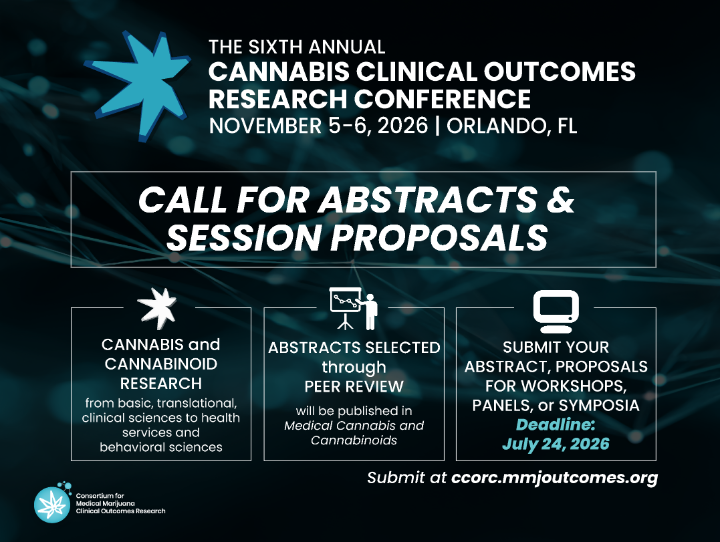
The Consortium for Medical Marijuana Clinical Outcomes Research is now accepting abstracts and session proposal submissions for the sixth annual Cannabis Clinical Outcomes Research Conference (CCORC) on November 5-6, 2026, in Orlando, Florida. The deadline to submit is July 24, 2026, 11:59 EST.
All submissions will be peer-reviewed and top abstracts will be invited for oral presentations. Abstracts and posters submitted by students will be considered for awards presented on the final day of the conference. All abstracts accepted by the conference will be published in the journal Medical Cannabis and Cannabinoids.
Student presenters from Consortium member universities are eligible to apply for travel support after abstract acceptance.
Please reach out to mmj.outcomes@cop.ufl.edu with any questions.
The Consortium for Medical Marijuana Clinical Outcomes Research is hosting its sixth annual conference, the Cannabis Clinical Outcomes Research Conference (CCORC), on November 5 & 6, 2026 at the UF Academic and Research Center at Lake Nona.
Take advantage of Early Bird Pricing for a limited time.

The Consortium for Medical Marijuana Clinical Outcomes Research received 34 letters of interest (LOI) from faculty from eight of its member institutions, in response to its eighth Request for Proposals (RFP) for the 2026 Research Grants Program.
After review and Board approval, the Principal Investigators of 31 LOIs were invited for full proposal submission. The Consortium received 28 full proposals that currently under review and award decisions regarding funding will be released by July 1st, 2026.
We invite you to be part of advancing the science of medical cannabis.
Our Medical Marijuana Contact Registry connects patients and providers with ongoing and future research opportunities aimed at better understanding the health effects of cannabis.
Individuals who enroll will be asked to provide their name and complete a brief set of questions. This information helps our research team determine eligibility for current studies and, when appropriate, reach out about new opportunities. Participation is always voluntary and begins with an informed consent process that clearly explains the purpose of the registry, what information is collected, and how confidentiality is protected.
You can join the registry—or help others get involved—by visiting: mmjoutcomes.org/registry
If you are a provider, consider sharing this opportunity with your patients or within your clinic.
Thank you for supporting research that aims to improve patient care and inform evidence-based use of medical cannabis. For additional materials or questions, please feel free to reach out to mmj.outcomes@cop.ufl.edu.
Dr. Karina Villalba, a 2025 Consortium grant awardee and Assistant Professor at the University of Central Florida, has recently received approval for her Investigational New Drug (IND) application.
Dr. Villalba's Consortium-funded project is titled, "Evaluating the Efficacy of Water-Soluble CBD in Reducing Risky Alcohol Use: A Randomized Controlled Trial." This double blinded randomized controlled trial will evaluate the preliminary efficacy of water-soluble CBD [Broad Spectrum (THC-free, 150 mg) vs. Full Spectrum (<0.3% THC, 150 mg) vs. placebo] in reducing alcohol use and cravings in individuals at risk for Alcohol Use Disorder (AUD).
Dr. Catalina Lopez-Quintero will lead a session at the Florida Medical Cannabis Conference and Exhibition (FMCCE) taking place on May 29-31 in Orlando, Florida. The session titled “Advancing the Science of Medical Cannabis: Research from Real-World Data to Clinical Trials,” is a multidisciplinary panel featuring Dr. Juan Pérez, Dr. Md Mahmudul Hasan, and Dr. Karina Villalba. The session will span real-world evidence from the Medical Marijuana and Me (M3) study, analyses of THC exposure and patient outcomes across conditions such as pain, anxiety, and sleep, and advances in data infrastructure through the MEMORY database. Learn more here.
Kendall Robinson will present research from the M3 study at the 2026 Research Society on Marijuana Annual Conference, taking place July 17–19 in Albuquerque, New Mexico. Robinson’s presentation is titled, “Beliefs and Informational Influences Contributing to Medical Cannabis Use Between Established and New Users in Florida.”
On April 15, Tracy Qu, an undergraduate and MPH student, presented a research poster titled “Medical Cannabis Edibles: Patient Use Patterns, Symptom Targets, and Perceived Benefit” at the University of Florida PHHP Days research conference. The poster summarizes the results of the Medical Marijuana & Me (M3) study and offers a comprehensive overview of epidemiological cannabis‑edible use in the state of Florida.
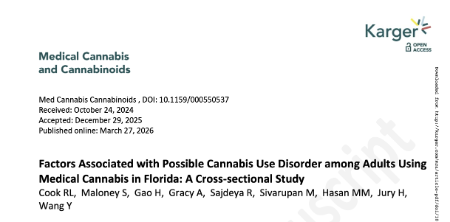
This publication explores factors associated with possible cannabis use disorder among adults using medical marijuana in Florida. Medical cannabis use continues to rise in the United States, yet little is known about the risk of Cannabis Use Disorder (CUD) among certified users. In a 2022 statewide survey of 632 adults in Florida, about 1 in 5 participants (20%) met criteria for possible CUD, while more than half (54%) demonstrated hazardous cannabis use patterns.
The study found that possible CUD was more likely among younger individuals, those with a longer history of daily cannabis use, and those using cannabis for recreational reasons rather than strictly medical purposes. Lower preference for oral concentrates was also associated with higher risk. CUD was not linked to sex, race, mental health conditions, or preferred THC strength. Despite the prevalence of risky use, very few participants expressed concern about addiction.
Medical Cannabis and Cannabinoids is the official journal of the Consortium, offering an international forum to investigate cannabis safety and effectiveness when used for medical purposes. This series in the newsletter, Journal Corner, provides updates, information and resources from the journal publisher, Karger.
New from Consortium Members
Medical Cannabis and Cannabinoids at a Glance
For more information or questions about Medical Cannabis and Cannabinoids, visit the journal website or contact: Alan Tootle, Publication Manager, a.tootle@karger.com
The Connect and Advance Research for Medical Marijuana Analysis (CARMMA) Database is accessible to researchers, physicians, and industry collaborators to foster collaborations in medical marijuana research.
Anyone interested in engaging in medical marijuana research is invited to register in CARMMA to find collaborators.

Don’t want to miss an issue of MEDICAMENT? You can join our mailing list today.
COMPLETE SIGN UP FORMWe value input from our readers and welcome feedback for upcoming MEDICAMENT issues.
COMPLETE FEEDBACK FORMYou can submit news and information to be shared in an upcoming MEDICAMENT.
COMPLETE SUBMISSION FORM