
The Consortium for Medical Marijuana Clinical Outcomes Research is hosting its sixth annual conference, the Cannabis Clinical Outcomes Research Conference (CCORC), on November 5 & 6, 2026 at the UF Academic and Research Center at Lake Nona.
The full program has been announced! View the agenda here.

James MacKillop, Ph.D.
Professor, Psychiatry & Behavioral Neurosciences
Director, Center for Medicinal Cannabis Research
McMaster University
Title of Presentation:
Using behavioral economics to understand cannabis use and misuse
Time: Thursday, November 5, 2026, 9:30 am

Nicholas DiPatrizio, Ph.D.
Professor, Biomedical Sciences
Director, UCR Center for Cannabinoid Research
University of California Riverside
Title of Presentation:
To eat or not to eat? Cannabinoid control of food intake and energy metabolism
Time: Thursday, November 5, 2026, 1:15 pm

Stephen Lankenau, Ph.D.
Professor, Community Health and Prevention
Director, Medical Cannabis Research Center
Drexel University
Title of Presentation:
Tolerance breaks and other forms of controlled cannabis use: Implications for clinical research and practice
Time: Friday, November 6, 2026, 9:15 am
* The three keynote addresses may be eligible for CME and CPE credits. Please see ccorc.mmjoutcomes.org/continuing-education-credit for more information.

Seven new awards along with one level 2 renewal were made in the 2026 cycle of the Consortium for Medical Marijuana Clinical Outcomes Research grants program.

Impact of Medical Marijuana Use on IL-22–Mediated Mucosal Immunity and Microbiome Composition in Inflammatory Bowel Disease
Mariola Ferraro, PhD
Associate Professor, Microbiology and Cell Science Department
Institute of Food and Agricultural Sciences
University of Florida
Project Narrative: This project investigates how use of medical marijuana (MMJ) and marijuana components influence mucosal immune function and gut microbiome composition in patients with inflammatory bowel disease (IBD), with a focus on IL-22–dependent epithelial defense pathways. This will lead to the identification of immune and microbiome signatures associated with MMJ use in IBD and clarify how cannabinoid signaling affects intestinal barrier function and inflammation.
Anticipated Impact: This study will provide evidence to help clinicians and patients make more informed decisions regarding MMJ use and contribute to future clinical guidance and policy decisions concerning its safety and therapeutic application in gastrointestinal disease.

Mechanistic Mapping of the Neuro-Inflammatory Impact of Medical Marijuana on Older Adults with Chronic Pain in a Prospective Cohort
Jennifer Hu, PhD
Professor, Epidemiology & Population Health Sciences
Miller School of Medicine
University of Miami
Project Narrative: The aims of this study are to: (1) to quantify the pain-relief effects of tetrahydrocannabinol (THC) and THC + cannabidiol (CBD) vs. non-users; (2) to map the molecular mechanisms of MMJ using 12 targeted neuroinflammatory biomarkers; and (3) to identify specific biomarkers/pathways that mediate the synergistic effects of THC+CBD.
Anticipated Impact: The anticipated impact is development of a biomarker-driven, anti-neuroinflammatory framework to improve MMJ-driven geriatric clinical pain outcomes.

Role of cannabinoid-based therapeutics in the prophylaxis and treatment of Alzheimer's dementia
Catherine Marcinkiewcz, PhD
Associate Professor, Department of Cellular and Systems Pharmacology
College of Pharmacy
University of Florida
Project Narrative: Cannabis use among older adults may have therapeutic value in preventing and ameliorating age-related neurodegenerative diseases like Alzheimer's disease (AD). This study will examine the interactions between THC use and AD progression, the potential interaction of THC with selective serotonin reuptake inhibitors (SSRIs) that are often prescribed for prodromal neuropsychiatric symptoms, as well as any unrecognized therapeutic benefits of restoring serotonergic signaling in the AD brain using THC-based compounds.
Anticipated Impact: New insights on whether tetrahydrocannabinol (THC) delays the onset of AD by potentiating serotonergic signaling in critical brain circuits may inform the development of novel pharmacotherapies for early AD.

Examining the interplay between high genetic risk for psychosis and cannabis exposure
Paola Giusti Rodríguez, PhD
Assistant Professor, Department of Psychiatry
McKnight Brain Institute, College of Medicine
University of Florida
Project Narrative: Cannabis use during adolescence has been linked to an increased risk for psychiatric disorders in individuals with an elevated genetic burden for these disorders, who are also more likely to use cannabis, complicating studies of gene-by-environment (GxE) interactions. This study will examine how adolescent cannabis exposure impacts behavior and cell type-specific gene expression using a mouse model of high genetic risk for psychosis.
Anticipated Impact: Understanding the interplay between psychiatric genetic liability and cannabis exposure at a critical developmental timepoint could have important public health and policy implications. The preclinical findings of this study could help inform the counseling of individuals at risk of psychosis, as well as individuals with psychosis regarding the medical use of marijuana.

AI-Powered Analysis of Cannabis Use and Mental Health Outcomes: Age-Stratified Evidence from EHR Data
Masoud Rouhizadeh, PhD, FAMIA
Assistant Professor, Pharmaceutical Outcomes and Policy
College of Pharmacy
Lead, AI Collab Hub, Intelligent Critical Care Center (IC3), AI in Health Sciences Initiative
University of Florida
Project Narrative: The relationship between cannabis use and depression is not clear, and the risk can be different for each age group. This project will use AI tools to identify cannabis use and depression in large-scale electronic health record (EHR) data. Pharmacoepidemiologic methods will be applied to measure the association between cannabis use and depression-related outcomes, including suicidality, separately in younger adults and older adults.
Anticipated Impact: Evidence generated will enable medical cannabis providers, public health officials, and policymakers to make informed decisions and communicate safety risks for each age group. The AI pipeline developed can be used to study other safety signals for medical cannabis clinical outcomes.

Assessing Risks and Benefits of Medical Marijuana Formulations in a Rodent Model of PTSD
Marek Schwendt, PhD
Associate Professor, Department of Psychology
Director of the Behavioral and Cognitive Neuroscience Program
College of Liberal Arts & Sciences
University of Florida
Project Narrative: This project will evaluate the behavioral and neurobiological effects of chronic voluntary cannabis consumption in a translational animal model of post-traumatic stress disorder (PTSD), while controlling for key clinically relevant factors, including the tetrahydrocannabinol (THC) to cannabidiol (CBD) ratio, sex, and stress susceptibility.
Anticipated Impact: The research will generate high-quality preclinical evidence on the efficacy and safety of oral medical cannabis formulations for reducing PTSD symptoms thus informing future clinical trials, patient care, and evidence-based policy decisions.

Advancing Nurse-led Cannabis Harm Reduction (ANCHOR)
Renessa Williams, PhD
Assistant Professor
School of Nursing and Health Studies
University of Miami
Project Narrative: This proposal focuses on young adults (18 – 35 years old) who self-medicate with cannabis and disproportionately use higher-risk, tetrahydrocannabinol (THC)-dominant products, yet face limited access to cannabis-informed clinical guidance and harm-reduction education. By developing and pilot testing ANCHOR, a cannabis nurse-led brief online intervention, this study will identify why THC-dominant products are preferred and use those findings to deliver product-specific harm-reduction counseling and referrals to reduce problematic use.
Anticipated Impact: Project findings may inform clinical decision-making about patient education, lower-risk use strategies, and referral pathways within medical marijuana (MMJ) care and may provide policy-relevant evidence to support integration of trained cannabis nurses into MMJ treatment models and guide standards for harm-reduction counseling.

Evaluation of the Effects of Cannabis on the Glymphatic System and Sleep Quality in People with Multiple Sclerosis
Teddy Salan, PhD
Research Assistant Professor, Department of Radiology
Miller School of Medicine
University of Miami
Project Narrative: The glymphatic system (GS), a waste clearance system for the removal of toxic waste products from the brain, plays a role in neurodegenerative diseases like multiple sclerosis (MS). GS activity is regulated by sleep and presents a potential mechanistic bidirectional pathway linking sleep disruption with MS progression. This study proposes to evaluate the effect of cannabis on GS function and sleep in people with MS (pwMS).
Anticipated Impact: This proof-of-concept study is the first of its kind to investigate the effect of cannabis on glymphatic clearance in relation to sleep in general, and in pwMS in particular. The findings are expected to further shed light on the therapeutic benefits of cannabis and its ability to modulate sleep and GS clearance in pwMS.
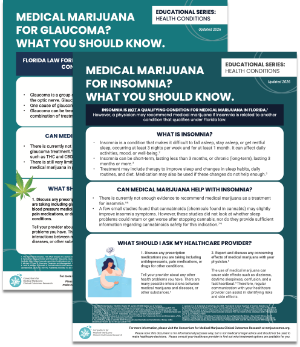
New info sheets have been created summarizing the evidence on effectiveness and safety of medical marijuana for the conditions of glaucoma and insomnia.
Other previously developed info sheets are focused on anxiety, Crohn’s disease, pain, epilepsy, and more.
We invite you to be part of advancing the science of medical cannabis.
Our Medical Marijuana Contact Registry connects patients and providers with ongoing and future research opportunities aimed at better understanding the health effects of cannabis.
Individuals who enroll will be asked to provide their name and complete a brief set of questions. This information helps our research team determine eligibility for current studies and, when appropriate, reach out about new opportunities. Participation is always voluntary and begins with an informed consent process that clearly explains the purpose of the registry, what information is collected, and how confidentiality is protected.
You can join the registry—or help others get involved—by visiting: mmjoutcomes.org/registry
If you are a provider, consider sharing this opportunity with your patients or within your clinic.
Thank you for supporting research that aims to improve patient care and inform evidence-based use of medical cannabis. For additional materials or questions, please feel free to reach out to mmj.outcomes@cop.ufl.edu.
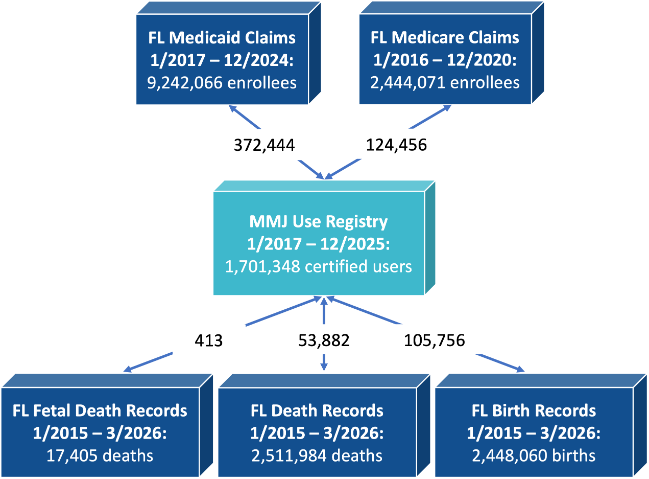
Total numbers by data source and the total number of linked individuals.

This research letter compared the prevalence of qualifying conditions among patients certified to use medical cannabis in Florida to population-based prevalence estimates for the same conditions and observed marked discrepancies. These findings highlight conditions that appear to be significant reasons for patients to consider medical cannabis, providing important research priorities for future research on its effectiveness and safety.
Medical Cannabis and Cannabinoids is the official journal of the Consortium, offering an international forum to investigate cannabis safety and effectiveness when used for medical purposes. This series in the newsletter, Journal Corner, provides updates, information and resources from the journal publisher, Karger.
New from Consortium Members
Medical Cannabis and Cannabinoids at a Glance
For more information or questions about Medical Cannabis and Cannabinoids, visit the journal website or contact: Alan Tootle, Publication Manager, a.tootle@karger.com
The Connect and Advance Research for Medical Marijuana Analysis (CARMMA) Database is accessible to researchers, physicians, and industry collaborators to foster collaborations in medical marijuana research.
Any researcher interested in finding collaborators for medical marijuana research is strongly encouraged to register in CARMMA.

Don’t want to miss an issue of MEDICAMENT? You can join our mailing list today.
COMPLETE SIGN UP FORMWe value input from our readers and welcome feedback for upcoming MEDICAMENT issues.
COMPLETE FEEDBACK FORMYou can submit news and information to be shared in an upcoming MEDICAMENT.
COMPLETE SUBMISSION FORM