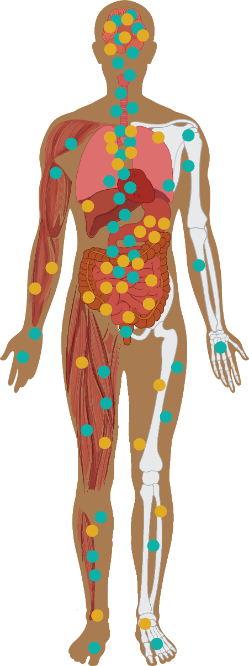
Your body naturally creates substances called endocannabinoids, and some of these are similar to the cannabinoids found in marijuana.
The body’s ECS sends “signals” (endocannabinoids) to “receivers” (CB1 and CB2 receptors) to help balance your body’s sleep cycle, appetite level, and more.
The cannabinoids in marijuana act in a similar way by connecting to the CB1 and CB2 “receivers” which can lead to different effects (e.g., increased appetite, changes in mood). But cannabinoids in marijuana are not identical to human cannabinoids and they are not the only component of marijuana.
It is not yet completely understood whether and how medical marijuana may help with a number of medical conditions.
 CB1 receptors
 CB2 receptors
 MUSCLES
Helps control blood sugar. Creates a feeling similar to a “runner’s high”.
 BONE
BONESupports bone mass and strength.
 CENTRAL NERVOUS SYSTEM
Supports the brain and central nervous system including increasing memory.
 IMMUNE SYSTEM
Affects the immune system to reduce swelling.
 HORMONES
Balances hormones that support metabolism, reproduction, and stress levels.
 DIGESTING FOOD
Helps control irritation and swelling in your digestive system.
Please note: This document is for informational purposes only, but is not medical or legal advice and should not be used to make healthcare decisions. Please consult your healthcare provider to find out what treatment options are available for you.
Ligresti A, De Petrocellis L, Di Marzo V. From Phytocannabinoids to Cannabinoid Receptors and Endocannabinoids: Pleiotropic Physiological and Pathological Roles Through Complex Pharmacology. Physiol Rev. 2016;96(4):1593-659.
Wilson RI, Nicoll RA. Endocannabinoid signaling in the brain. Science. 2002;296(5568):678-82.
Zlebnik NE, Cheer JF. Beyond the CB1 Receptor: Is Cannabidiol the Answer for Disorders of Motivation? Annu Rev Neurosci. 2016;39:1-17.
Updated 2023